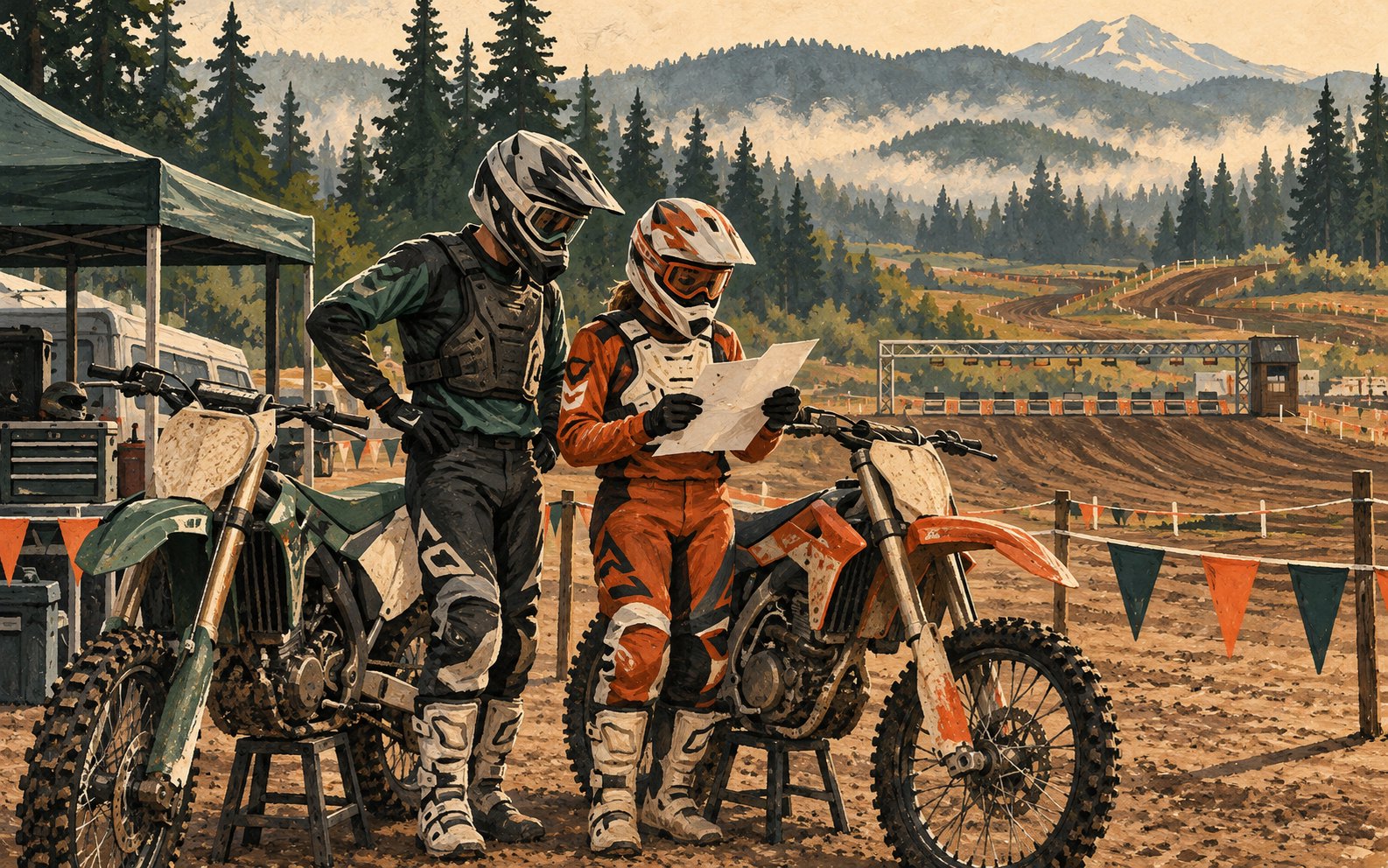
Start with a day you can manage
Your first local race can have a modest goal: understand the routine, ride within your ability and leave knowing what to prepare next time. You do not have to make the day a verdict on your speed. A manageable entry gives you room to hear instructions, ask questions and experience the difference between practicing at a track and sharing a race program with several classes.
Sort the entry before loading
The AMA’s beginner guide identifies class selection, registration, a track walk, practice, the riders’ meeting, staging and results as parts of the race-day process. Use that sequence to make a personal checklist. Ask the promoter which class fits your age, motorcycle and racing experience, and what memberships, releases, equipment and identification that particular event requires. [1]
Write down your confirmed class exactly as entered, including any age, skill or machine qualifier. Add your bike number and the organizer’s contact details. If something on the registration form does not describe you accurately, resolve it before race morning. Our suggestion for a first visit is to keep the entry simple; adding classes also adds places you must be at the right time.
Check-in is a separate job
Washougal’s Classic 7 instructions require tower check-in even after online registration, including confirmation of classes and bike number. The series uses Trackside transponders. Paying online therefore does not finish every race-morning task. [2]
On arrival, find registration, the official notice board, the riders’ meeting location and the authorized route to staging. Ask where your practice assignment and race order will appear. Put wristbands, paperwork and any timing equipment in order before getting distracted by unloading the whole campsite. If you need help, an official who knows this event is a better source than a confident guess from a neighboring pit.
Practice has its own order
Woodland’s Winter MX page directs riders to the tower for practice and race order, with the riders’ meeting after practice. That is a local example of why the posted program matters more than a routine remembered from another track. [3]
Give practice a learning purpose: identify the circuit, locate entry and exit points, notice flag positions and establish a pace you can repeat comfortably. Ask officials about anything unclear before entering. Do not follow another class onto the track because its bikes look similar. This guide is preparation for the event routine; it does not teach jumping, starts or other riding techniques.
In its first-timer guide, PIR’s Thursday Night Motocross describes a course walk before riding, a practice ticket and assigned group, the riders’ meeting, and staging one race ahead. Its normal program uses two motos. Walk only when the track is closed to riding and officials permit it; do not assume that access is available while practice or racing is active. [4]
Build a race card you can read at a glance
After the meeting, make a simple card with your class, race-order position, staging location and any instructions officials gave. Use the posted order to track progress rather than predicting a start from the wall clock. Delays and changes are reasons to check the official board again. Ask how this event calls riders and where changes will be announced; a phone left in the camper is not much help if that is where you saved everything.
Between motos, return to your pit, drink, eat as appropriate and check how you and the bike are doing. Leave enough time to get dressed and reach staging without rushing. If something feels wrong, stop and get appropriate help. Finishing an entry is never a reason to ignore an injury or an unresolved motorcycle fault.
Pit-box option: JACO Elite Low Pressure Tire Gauge · 30 PSI (Amazon paid link). Use it for cold checks before riding when your specified pressure is within its 2–30 PSI working range. Do not bleed a warm tire to a cold target; follow your tire and motorcycle instructions. We may earn a commission from qualifying purchases.
How two finishes become an overall
Under the AMA’s ordinary two-moto scoring rule, the lower total of finishing positions wins, with the final moto breaking a tie. In a hypothetical class, a rider going 2–1 beats a rider going 1–2: both total three, but the first rider finishes ahead in moto two. Practice may be timed under the rules, so ask how this event determines gate selection. [5]
Read the posted result for the correct class and bike number. If you think there is an error, ask an official about the applicable review or protest process promptly; do not assume a live timing screen is the final authority. Before leaving, record one useful observation about preparation and one about riding. A first race is a good day when the next one feels more understandable.
One useful item for the pit box
A suitable gauge supports cold-pressure checks before riding. It does not choose the setting for your motorcycle or turn a warm reading into a cold target.
Affiliate disclosure: As an Amazon Associate I earn from qualifying purchases. These Amazon links are paid links. How our links work.
JACO Elite Low Pressure Tire Gauge · 30 PSI
An analog gauge with a pressure-hold reading and a bleeder button. JACO specifies a working range of 2–30 PSI for this low-pressure model.
Before you buy: Use only when your required pressure is within 2–30 PSI. Confirm valve access and the analog 30 PSI version; this gauge does not set the correct pressure for your bike or replace suitable bead-seating equipment.
View on Amazon (paid link) — JACO Elite Low Pressure Tire Gauge · 30 PSI, Elite 30 PSI (analog)Manufacturer details · Elite 30 PSI (analog)Product selections are based on manufacturer information, with no hands-on testing claimed. Confirm the exact model, compatibility, package contents, seller and current price before buying.
Sources & riding information
- AMA: getting started in motocross.
- Washougal: Classic 7 series rules and check-in.
- Woodland: 2026–27 Winter MX series.
- Thursday Night Motocross: first-time racer guide.
- AMA: 2026 amateur racing rulebook.
Sources checked Oct 22, 2026 (UTC). Event arrangements and class rules vary; confirm the organizer’s current instructions. Written guidance does not replace hands-on instruction.