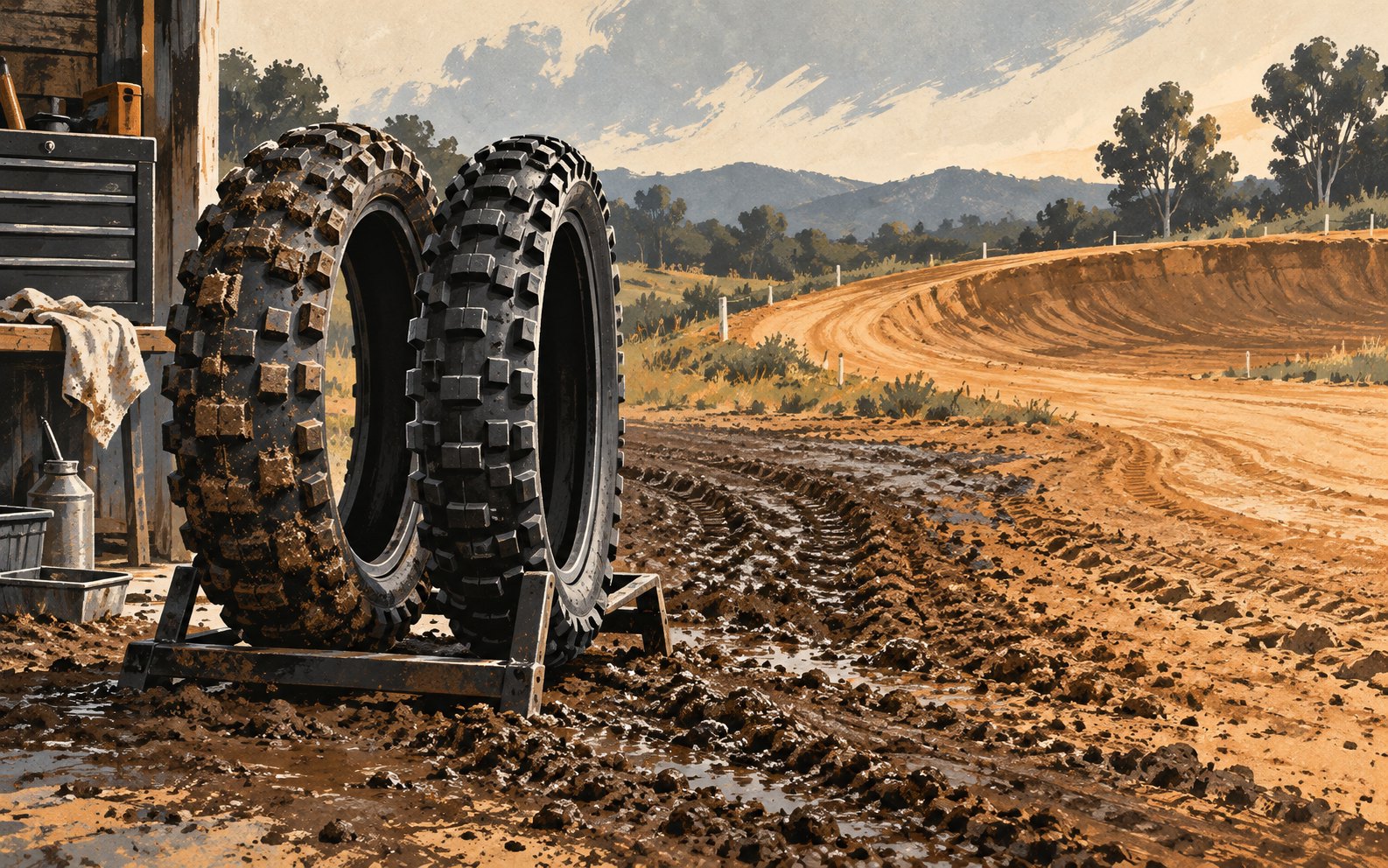
The replacement has a specific job
Dunlop identifies the Geomax MX54 as the direct replacement for MX53. Its May 20, 2026 US announcement targets intermediate-to-hard motocross conditions, emphasizing consistency as a track dries and firms. This is a documented product comparison, not a WrenchMoto tire test. [1]
The announced changes cover both ends of the bike. Dunlop says the rear tread draws from its Factory Spec tire, while the front gets a new pattern aimed at steering, braking and line holding. PCBT Advanced block design, an updated compound and revised carcass construction complete the stated package. Improvements in drive, slide control, wear and predictability are manufacturer claims; we have not measured them against MX53. [1]
What carries over from MX53
MX53 was already an intermediate tire with hard-ground capability, rather than a specialist sand design. Dunlop’s older product documentation describes Carcass Tension Control, Advanced Apex Design and Progressive Cornering Block Technology. The latter name therefore does not, by itself, identify an entirely new feature on MX54. The comparison is about the implementation of blocks, rubber and construction, not the arrival of cornering technology from nothing. [2]
For an owner happy with MX53, our buying question is narrower than “is the new one better?” Ask where the old setup falls short. Is the concern front-end feedback late in the day, rear drive on the main racing line, or simply replacing a worn tire? Write that down before shopping. It gives the next purchase a purpose and makes your own observations more useful than a general expectation of improvement.
Read the technology as a design explanation
Dunlop’s European MX54 page describes fewer, larger blocks, revised distribution between the center and shoulders, and a high-resilience compound. It links these changes to ground contact, block rigidity and wear resistance. Its table lists tube-type examples including an 80/100-21 front, 100/100-18 and 110/100-18 rears, plus several 19-inch rears. The same regional table spans mini-bike through full-size wheel applications. These are catalog offerings, not a fitment recommendation for every bike using those rim diameters. [3]
The US catalog also lists youth fitments such as 70/100-17 and 70/100-19 fronts, an 80/100-21 front and a 70/100-10 rear. Check the current US chart and the exact stock code with your supplier; a regional catalog does not establish local inventory or make every size interchangeable. [4]
Make the purchase comparison fair
Compare front with front and rear with rear in the approved specification for your motorcycle. Ask the installer to confirm rim compatibility, tube requirements and the complete tire designation. Our recommendation is to request an itemized, installed quote for each candidate rather than comparing the cheapest small-wheel listing with a full-size rear. No verified size-matched US manufacturer price pair is quoted here.
An earlier-model rear listing: Dunlop Geomax MX53 Rear Tire · 110/100-18 (Amazon paid link). This is one MX53 110/100-18 rear, not MX54 and not a 19-inch rear. Compare it only with the rear specification approved for your motorcycle and wheel. The separate front listing does not establish that these sizes form the correct pair for your bike. We may earn a commission from qualifying purchases.
If a remaining-stock MX53 is cheaper, put the actual discount beside the reason for changing. A rider seeking a replacement for familiar terrain faces a different decision from someone trying to address a particular handling complaint. Neither the model number nor a sale sticker resolves that choice. The fitment and condition of the tire still belong at the center of it.
Earlier-model shopping option: Dunlop Geomax MX53 Front Tire · 80/100-21 (Amazon paid link). This link is an MX53 80/100-21 front tire. It is not MX54, and we have not verified an MX54 Amazon listing. Compare the exact size and condition rather than assuming a price difference. We may earn a commission from qualifying purchases.
What a useful comparison would record
For your own riding notes, record the exact front and rear sizes, condition of the previous tires, terrain and setup. Avoid interpreting one good session after replacing badly worn rubber as proof of a model-wide advantage. A credible back-to-back comparison would need comparable tires and documented conditions. Until then, MX54’s design changes are confirmed; their value for your riding remains something to evaluate.
Record the setup as well as the tire: JACO Elite Low Pressure Tire Gauge · 30 PSI (Amazon paid link). For an air-filled setup, use the motorcycle and tire instructions to establish the cold pressure. This gauge works from 2–30 PSI; choose another range when required. It does not measure a mousse setup. We may earn a commission from qualifying purchases.
Related guide: Choose off-road tires for the ground you actually ride.
Earlier MX53 front and rear listing examples
These are separate earlier-model MX53 listings: an 80/100-21 front and a 110/100-18 rear. They are size examples, not a recommended matching pair for every bike. No MX54 Amazon listing has been verified. The gauge is a separate option for air-filled setups within its 2–30 PSI working range; it does not measure a mousse setup.
Affiliate disclosure: As an Amazon Associate I earn from qualifying purchases. These Amazon links are paid links. How our links work.
Dunlop Geomax MX53 Front Tire · 80/100-21
An individual MX53 front tire in 80/100-21. This is the earlier model discussed in the comparison, not an MX54 listing or a front-and-rear pair.
Before you buy: Confirm the complete tire designation, approved motorcycle and rim fitment, tube requirements and condition with the supplier. This motocross selection is not a public-road recommendation; do not transfer MX54 specifications to MX53.
View on Amazon (paid link) — Dunlop Geomax MX53 Front Tire · 80/100-21, MX53 front / 80/100-21Manufacturer details · MX53 front / 80/100-21Dunlop Geomax MX53 Rear Tire · 110/100-18
One MX53 rear tire in 110/100-18. The inspected Amazon title and selected size agree, and its item details identify part number 45236568. This is the earlier MX53, not MX54.
Before you buy: Confirm the complete designation, approved motorcycle and rim fitment, tube requirements and condition with the supplier. This 18-inch rear is not interchangeable with a 19-inch rear. It is not a set or a public-road recommendation.
View on Amazon (paid link) — Dunlop Geomax MX53 Rear Tire · 110/100-18, 45236568Manufacturer details · 45236568JACO Elite Low Pressure Tire Gauge · 30 PSI
An analog gauge with a pressure-hold reading and a bleeder button. JACO specifies a working range of 2–30 PSI for this low-pressure model.
Before you buy: Use only when your required pressure is within 2–30 PSI. Confirm valve access and the analog 30 PSI version; this gauge does not set the correct pressure for your bike or replace suitable bead-seating equipment.
View on Amazon (paid link) — JACO Elite Low Pressure Tire Gauge · 30 PSI, Elite 30 PSI (analog)Manufacturer details · Elite 30 PSI (analog)Amazon identities and selected variants were inspected, with manufacturer pages linked where available. Confirm the actual product code, generation, size, package contents and seller before buying. The article’s dated manufacturer prices are not current Amazon offers. No hands-on testing or comparative performance or protection result is claimed.
Check the tools and wheel-support notes before planning installation ↗
Sources & technical information
- Dunlop manufacturer release: MX54 changes, May 20, 2026.
- Dunlop: MX53 design and intermediate-terrain positioning.
- Dunlop: MX54 technology and regional size table.
- Dunlop USA: MX54 fitments.
Sources checked Oct 22, 2026 (UTC). Fitment, specifications and procedures vary; confirm the current manufacturer instructions for your exact bike and component.