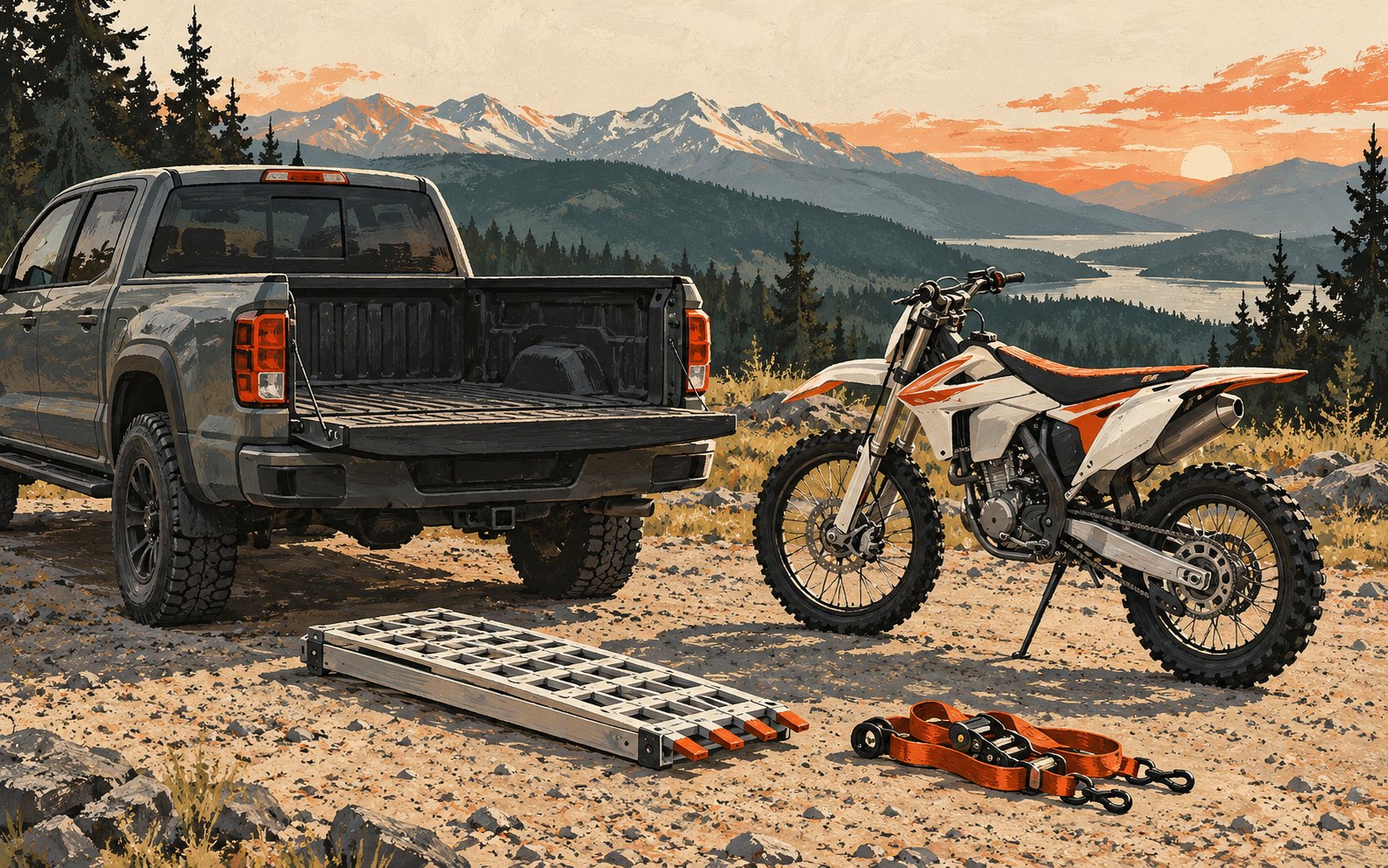
Plan the whole trip before the loading moment
A motorcycle can fit inside a vehicle’s footprint without the complete transport arrangement being suitable. Our planning framework is to list the bike, transport vehicle or trailer, loading equipment, restraint components and everyone helping. Then identify which manufacturer’s instructions answer each question. A photograph of someone else’s setup cannot establish your load limits, attachment points or loading method.
Start with the motorcycle’s own guidance
The 2022 Honda CRF250F manual provides a model-specific transport example: it recommends a loading ramp and motorcycle tie-down straps with the bike upright, and warns against rope that can loosen. It also says straps must not contact control cables or electrical wiring. Read the full procedure for your exact bike, rather than transferring the CRF250F’s attachment directions to different bars, controls or accessories. [1]
Read ratings as a system
US Cargo Control explains that a restraint’s working load limit is constrained by its lowest-rated component or anchor point. A strong strap does not upgrade a weaker fitting. Have the required ratings and securement arrangement confirmed for your complete setup. This guide supplies no universal strap count, anchor layout or numerical load calculation, because those need the actual equipment and its applicable instructions. [2]
Check the equipment before the next departure
US Cargo Control’s inspection guidance includes webbing, stitching, hardware and legible working-load information, and says damaged equipment should be removed from service. Follow the instructions for your actual restraints. Lay them out in advance so an unreadable label, damaged hook or frayed section becomes a replacement decision at home, rather than a reason to improvise at the end of a long day. [3]
Ask the ramp questions in advance
For the actual ramp and transport vehicle, confirm the permitted loading height, rated load, support and securing requirements, and the method the instructions allow. Include the people or additional equipment required for that method. Do not assume that a ramp’s presence authorizes riding the motorcycle up it. If you cannot establish the approved arrangement and carry it out safely, choose suitable equipment and qualified assistance before loading.
Give vehicle capacity its own check
Use the actual vehicle and trailer documentation for payload, permitted towing setup, loading distribution and rated attachment points. Count the rest of the trip’s load too: people, riding equipment, tools and other cargo. A larger cargo area is not automatically a higher payload allowance. This is a prompt to obtain the correct figures, not a substitute set of ratings or a declaration that a particular vehicle can carry your bike.
Rehearse the plan without improvising a procedure
Agree on a clear level working area, the instructed sequence and each helper’s role before moving the motorcycle. Keep children and other bystanders out of the work area. Resolve communication and stopping points first. If the approved method is unfamiliar, get suitable instruction and assistance; urgency is a poor reason to experiment with a heavy moving motorcycle or a makeshift platform.
Remember everything that is not the motorcycle
Secure the ramp and loose equipment for transport using their instructions as well. Plan how you will access riding gear and paperwork without disturbing the motorcycle’s restraint system. A simple inventory helps: bike securement checked, loading equipment in its transport position, other cargo secured, and required vehicle/trailer checks completed. These are planning prompts, not a complete towing or roadworthiness checklist.
Make unloading part of the same decision
Think about the destination before departure: the available permitted space, surface and help, and whether the same approved method can be used there. Follow the equipment makers’ recheck instructions during the journey, and reassess if anything changes. A good transport plan ends with a controlled unloading arrangement, not merely a motorcycle that made it into the truck at home.
Related guide: Plan a first trail loop with an easy way home.
Related guide: Make a race weekend work for the whole family.
Sources & riding information
- Honda: 2022 CRF250F manual, transporting your motorcycle, printed pages 118–119.
- US Cargo Control: working load limits and restraint-system components.
- US Cargo Control: tie-down inspection and removal from service.
Sources checked Oct 23, 2026 (UTC). This guide supports planning and questions for qualified help; it is not a model-specific service, inspection or loading procedure.