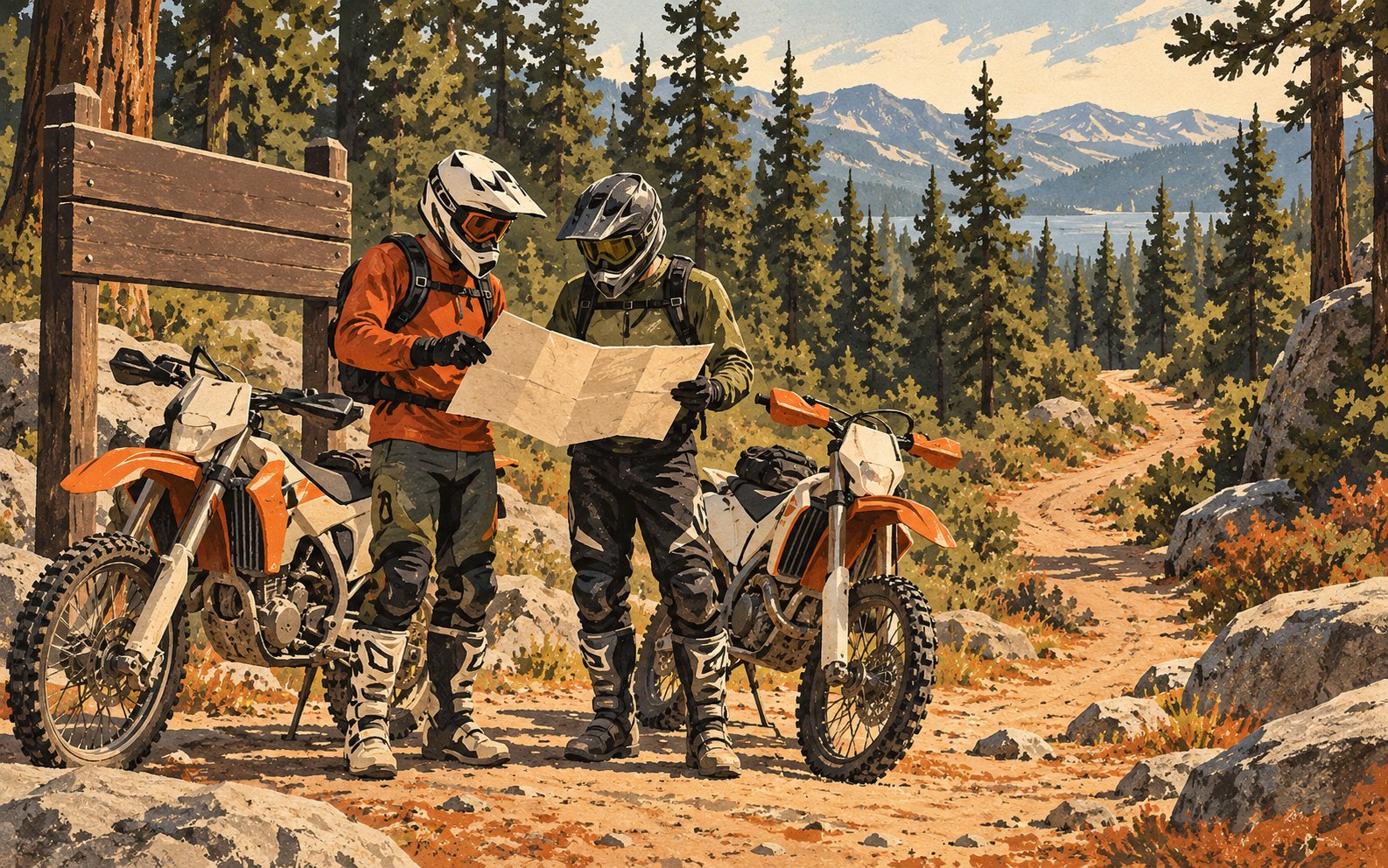
For a first visit to a trail system, WrenchMoto’s planning suggestion is simple: choose a compact route with a straightforward return to the staging area. Mark the decision points before leaving home. An optional extension can wait until everyone has assessed the riding, the conditions and the time remaining.
On national forests, start with the current Motor Vehicle Use Map. The Forest Service explains that it identifies designated routes, vehicle categories and seasonal allowances. Pair it with a detailed navigation map, because an MVUM does not supply topographic detail. Check every connecting segment, including any road used to link two trails. [1]
Check status before departure
Confirm the day’s situation with the land manager. Oregon Parks and Recreation recommends checking whether the OHV area is open, asking about trail and weather conditions, and knowing the local rules before traveling. A route drawn on a map should prompt a status check before departure. [2]
Save the information you will need before losing reception. Oregon’s riding-area directory notes that many locations provide downloadable maps, including PDFs usable on a phone without service. Our practical check: open the saved files offline at home, confirm the legend is readable and carry a paper backup. [3]
For reading saved route information while stopped: Black Diamond Astro 300 · Graphite (Amazon paid link). A headlamp can be useful for stationary map checks and packing in low light. Confirm batteries and package contents. It is not motorcycle lighting, a navigation device or a reason to extend the route past your planned turnaround. We may earn a commission from qualifying purchases.
Ride with a partner and leave your destination, planned route and expected return with someone who is staying behind. Oregon’s guidance also recommends carrying water, food, first-aid supplies, navigation and communication equipment. Pack for an unplanned delay as well as the advertised mileage. [2]
For carrying water on the planned loop: USWE Moto Hydro 3L · Black (Amazon paid link). Verify the exact reservoir and pack generation before ordering, then check fit with your actual riding equipment. Choose your water supply for the day’s needs rather than assuming the model name states water capacity. This does not establish compatibility with an airbag system. We may earn a commission from qualifying purchases.
Before setting off, agree on a turnaround time and a shorter alternative. Account for stops, navigation and the slowest rider rather than scheduling every minute as moving time. If the first section already feels demanding, choose the shorter day. Returning with energy left is a useful result for a first visit.
Water-carrying and stopped-task lighting
A pack and a small headlamp serve different jobs in trail-day preparation. Choose capacity around your actual route, conditions and equipment; these two items are not a complete ride or emergency kit.
Affiliate disclosure: As an Amazon Associate I earn from qualifying purchases. These Amazon links are paid links. How our links work.
USWE Moto Hydro 3L · Black
The inspected Amazon title identifies a black USWE Moto Hydro 3L. Confirm the exact generation and supplied reservoir with the seller before applying the manufacturer example in this guide.
Before you buy: The manufacturer example separates 3L total volume from 2L water capacity; do not read the listing’s 3L name as three liters of drinking water. Verify package contents, reservoir model, harness version and your measurements. Try it with your actual equipment. Backpack fit does not establish airbag compatibility; follow the protective-system instructions and authorized fitting advice.
View on Amazon (paid link) — USWE Moto Hydro 3L · Black, Moto Hydro 3L / Black (listing title)Manufacturer details · Moto Hydro 3L / Black (listing title)Black Diamond Astro 300 · Graphite
Selected Amazon variant: Astro 300, BD Graphite, 300 (AAA Powered).
Before you buy: Confirm the AAA version and complete package before ordering; Astro 300-R is a different product. Ask about the recipient’s battery preference. Use this for packing, walking and stationary tasks, not motorcycle lighting.
View on Amazon (paid link) — Black Diamond Astro 300 · Graphite, Astro 300 / BD Graphite / AAA versionManufacturer details · Astro 300 / BD Graphite / AAA versionOptional packing additions based on previously verified listings and manufacturer information. No hands-on test or universal capacity recommendation is claimed. Keep the route, return time, navigation backups and communication plan independent of these purchases.
Sources & riding information
- U.S. Forest Service: motor vehicle use maps and navigation maps.
- Oregon Parks and Recreation: trip planning and safe riding practices.
- Oregon Parks and Recreation: riding-area maps and land managers.
Sources checked Oct 22, 2026 (UTC). Access and conditions can change; check current land-manager guidance. Written advice does not replace hands-on instruction.