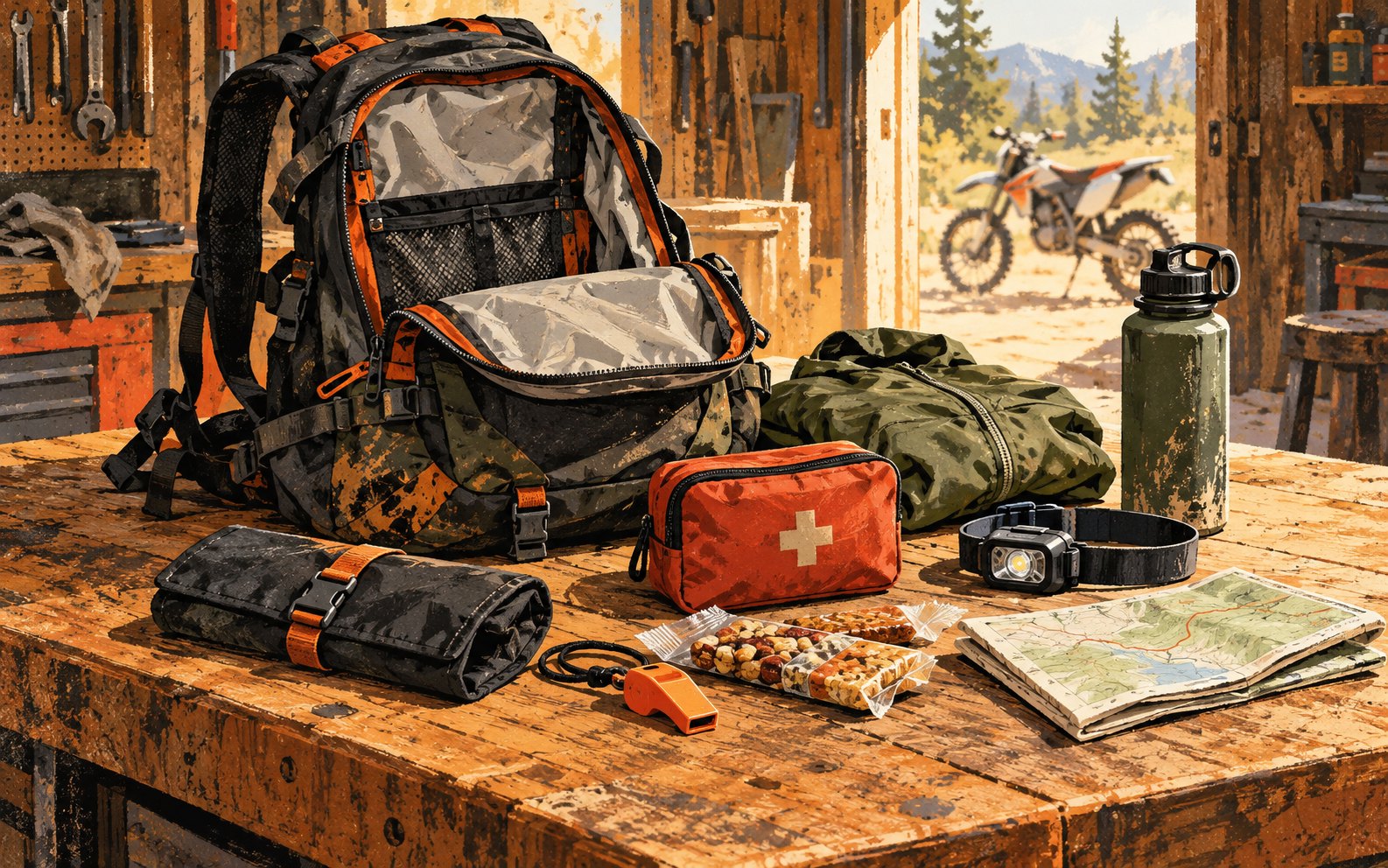
A useful trail pack answers a question: what would you need if the ride took longer than expected? WrenchMoto’s suggestion is to think through a delayed return, a long stationary stop and a lost route before choosing a bag. Equipment that solves those problems earns its space more clearly than an assortment of interesting accessories.
The National Park Service’s Ten Essentials provides a starting framework for outdoor trips. It groups equipment by functions including navigation, lighting, extra clothing, first aid, food, water, repair tools and emergency shelter. The agency emphasizes adapting the list to the activity. It is a planning reference, not a motorcycle-specific packing prescription. [1]
Make the basics usable
Carry navigation equipment you know how to use. NPS recommends a physical map backup and spare power for a phone; it also identifies a headlamp as a useful hands-free light. Pack layers for changing conditions and check the dates and contents of first-aid supplies before relying on them. [1]
For repair supplies, NPS recommends matching tools to the activity rather than treating a generic multi-tool as the whole answer. Our motorcycle-specific question is which problems you are trained and equipped to address. Confirm suitable tools against your bike’s manual; carrying a tool does not establish that a trail-side repair is appropriate. [1]
Compact tool option: Motion Pro T6 Combo Lever · 32 mm (Amazon paid link). This example has a 32 mm box end: confirm your axle nut size and tool limits first. A spoon and core tool alone are not a complete puncture-repair kit; include the compatible supplies and skills your plan requires. We may earn a commission from qualifying purchases.
Organize the bag while wearing your normal riding equipment. Our practical check is to locate the map, light and first-aid pouch without emptying everything onto the ground. Keep items secured, then assess comfort and access while stationary. A kit that only works when unpacked across a workbench deserves another arrangement.
After each ride, replace what you used and note what was missing. Review the load whenever the season, location or group changes. This is also a useful moment to agree who carries shared equipment, while keeping personal essentials with their owner. A lighter bag is helpful only if it still answers the problems you planned for.
What goes in our editor’s trail tool kit
These are our editor’s personal packing habits. Add them to a plan for your own bike, route and repair skills; they do not replace the water, layers, navigation and other essentials discussed above.
Two-stroke: a spare plug and a tool that reaches it
For a two-stroke, our editor carries a spare spark plug and a dedicated spark-plug tool. Match the plug to the exact engine specification, protect it in the pack and confirm the tool’s hex size and access at home. Check the specified gap and installation instructions before the ride.
NGK advises removing and installing plugs with the engine cool. Use the motorcycle and plug maker’s installation guidance; a roadside tool kit is not a reason to guess at thread engagement or tightening.
NGK: spark-plug installation · NGK: checking the specified gap
Baling wire, duct tape and a reversible-bit screwdriver
Our editor adds a small amount of baling wire, duct tape and a screwdriver with a reversible bit. The packing trick is to wrap a compact supply of tape around the screwdriver shank instead of carrying a full roll—just enough to fit comfortably in the backpack. Keep the bit change and working end accessible.
Choose the bit ends for the fasteners actually on the motorcycle. Treat wire and tape as supplies for suitable temporary fixes, not a way to keep riding with a failed brake, steering component, wheel or other critical part. Stow the wire so its cut ends cannot puncture the bag or nearby supplies.
Cutting pliers plus small or medium Cobra pliers
Pliers with a cutter earn a place in the kit, especially alongside the baling wire. Our editor also likes a small or medium pair of KNIPEX Cobra pliers as a versatile second gripping tool. Carry cutting pliers as well: Cobra water-pump pliers are gripping tools.
Our editor has used the Cobras as a spark-plug wrench on accessible two-strokes when caught short. They can earn their space as a backup, but check jaw access on your own bike at home and keep the dedicated spark-plug tool in the kit.
Compact tools to consider for your own kit
These are optional additions to a bike-specific repair kit. The combo lever shown has a 32 mm box end; choose it only if that size and its tool limits suit your motorcycle.
Affiliate disclosure: As an Amazon Associate I earn from qualifying purchases. These Amazon links are paid links. How our links work.
Motion Pro T6 Combo Lever · 32 mm
An aluminum tire spoon with a 32 mm axle-nut box wrench at the other end. A useful combination for the tool kit, track box or tail kit.
Before you buy: Match your axle nut and the manufacturer’s tool torque limit. We prefer small-tip irons for tube work; broad spoons need extra care to avoid catching a tube.
View on Amazon (paid link) — Motion Pro T6 Combo Lever · 32 mm, 08-0289Manufacturer details · 08-0289Lisle 15190 Valve Core Tool
A screwdriver-style handled tool with a heat-treated steel tip for removing and installing standard valve cores.
Before you buy: This is the bench style we prefer. A suitable valve-cap core tool works too; check whether your tube already came with one.
View on Amazon (paid link) — Lisle 15190 Valve Core Tool, 15190Manufacturer details · 15190Product selections are based on manufacturer information, with no hands-on testing claimed. Confirm the exact model, compatibility, package contents, seller and current price before buying.
Sources & riding information
Sources checked Oct 22, 2026 (UTC). Access and conditions can change; check current land-manager guidance. Written advice does not replace hands-on instruction.