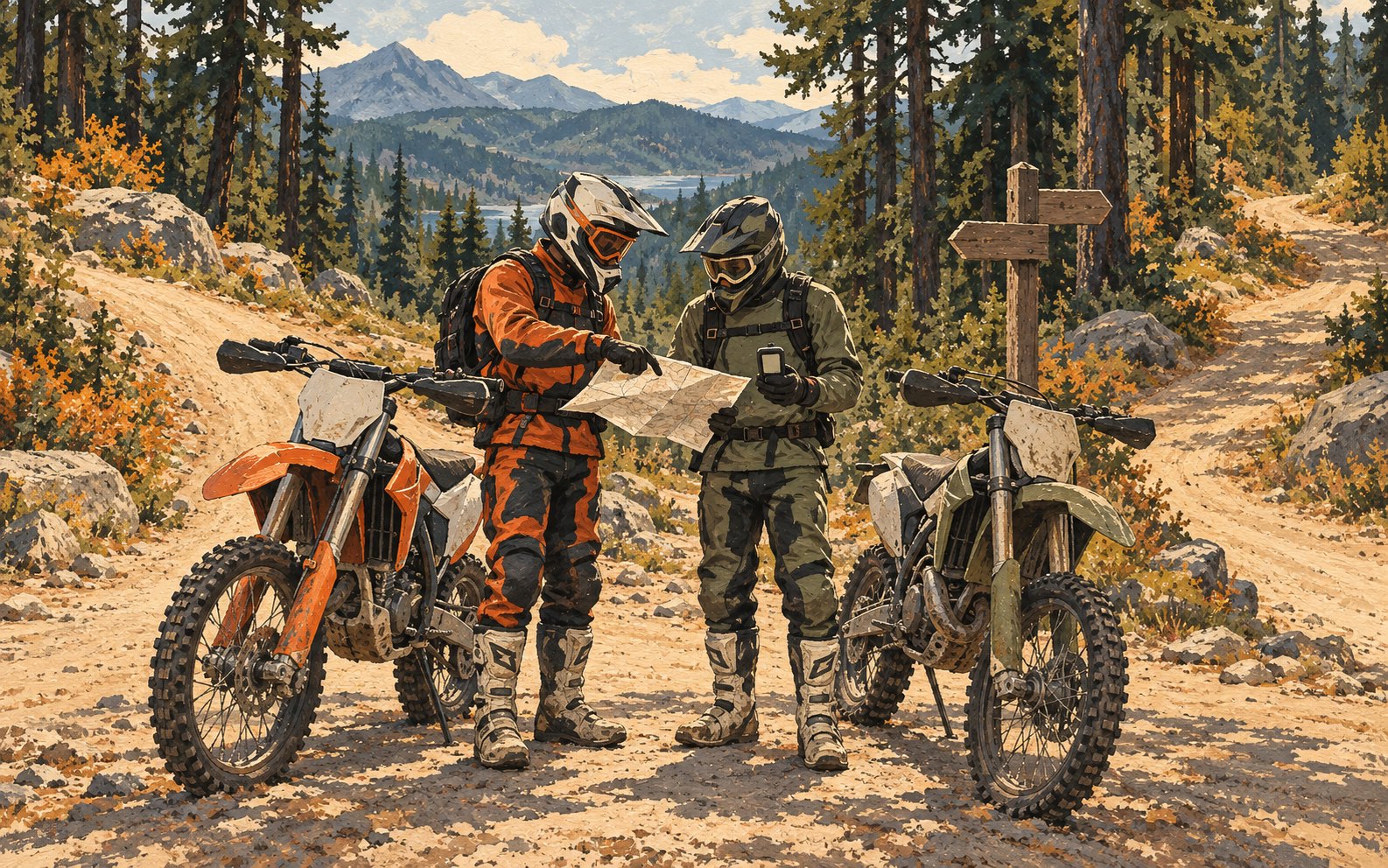
A junction that does not match your expectations is a reason to pause, not to accelerate toward a better-looking guess. WrenchMoto’s practical suggestion is to stop safely where you are not blocking the route, gather the group and identify the last place everyone could confidently locate. Keep the discussion stationary, with attention off the moving motorcycle.
The National Park Service’s Outdoor Emergency Plan recommends calming down and using a map, compass, GPS or visible landmarks to establish your position. It permits retracing the route only when safe. That is different from blindly reversing direction: any proposed return also needs to respect the route’s current access and direction restrictions. [1]
Know when the problem has changed
If you cannot safely retrace the route, the NPS plan advises seeking help. Its U.S. guidance says to call 911 and provide coordinates if available, the area where you started, your last known location and recognizable surroundings. Once seeking help, stay put unless there is an immediate threat to life. [1]
No phone reception does not make more random travel a solution. The same plan emphasizes conserving resources, protection from the elements and signaling for help while awaiting rescue. Prepare for that possibility before setting out; do not assume an untested device or a hoped-for signal will resolve the situation. [1]
A trusted contact can help only with information you actually left. NPS’s Trip Plan guidance recommends sharing your itinerary with someone staying behind and notifying that person when you switch to a backup plan or finish. The form itself does not trigger rescue, and NPS says parks do not accept it as a trip-monitoring service. [2]
For the next ride, practice matching junctions and landmarks to your saved information while the consequences are small. Our suggestion is to compare what you expected with what you found at the uncertain junction, then adjust the preparation that failed. The aim is a clearer decision process, not confidence in a particular app or an assumption that help will be immediate.
For low-light map checks while stopped: Black Diamond Astro 300 · Graphite (Amazon paid link). Confirm the AAA-powered version and batteries before packing. This is task lighting, not motorcycle lighting or a navigation or rescue device. Keep the article’s stop, reassess and seek-help decisions independent of any equipment purchase. We may earn a commission from qualifying purchases.
A light for stationary map checks
Consider lighting during preparation, before you need it. This small headlamp is an optional aid for reading route information while safely stopped.
Affiliate disclosure: As an Amazon Associate I earn from qualifying purchases. These Amazon links are paid links. How our links work.
Black Diamond Astro 300 · Graphite
Selected Amazon variant: Astro 300, BD Graphite, 300 (AAA Powered).
Before you buy: Confirm the AAA version and complete package before ordering; Astro 300-R is a different product. Ask about the recipient’s battery preference. Use this for packing, walking and stationary tasks, not motorcycle lighting.
View on Amazon (paid link) — Black Diamond Astro 300 · Graphite, Astro 300 / BD Graphite / AAA versionManufacturer details · Astro 300 / BD Graphite / AAA versionOptional preparation equipment based on a previously verified listing. No navigation accuracy, emergency signaling performance, rescue outcome or runtime is promised. No hands-on testing is claimed.
Sources & riding information
- National Park Service: Outdoor Emergency Plan, navigation uncertainty and seeking help.
- National Park Service: sharing a Trip Plan with a trusted contact.
Sources checked Oct 22, 2026 (UTC). Access and conditions can change; check current land-manager guidance. Written advice does not replace hands-on instruction.