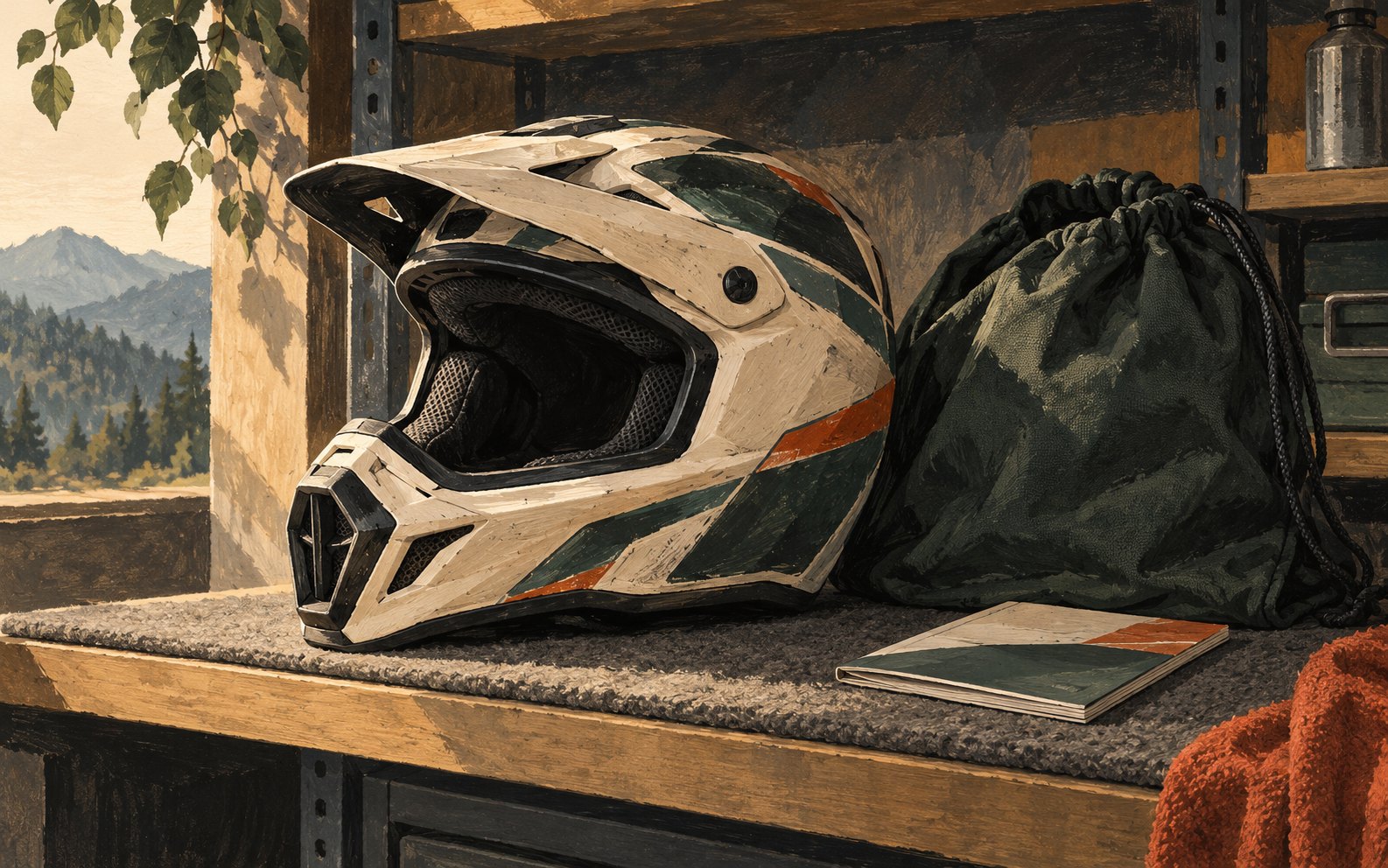
Pause the riding decision first
After a significant helmet impact, set it aside and follow the maker’s replacement guidance before riding again. An intact-looking finish cannot overrule that guidance. This equipment guide cannot diagnose a helmet or assess the rider’s medical condition. [1]
Hidden damage changes the question
SHOEI recommends replacing a helmet that sustained significant impact while being worn, because damage to the foam liner may exist without obvious external signs. Its impact-service page also says most submitted helmets are not approved. Cleaning, a new peak or a new comfort liner should not be treated as an answer to that impact question. [1]
Ask about a real service, not a generic promise
SHOEI’s US evaluation service applies to eligible authentic helmets within its stated warranty and purchase conditions. Read the current requirements before arranging anything; the service is not an all-brand inspection offer. If your manufacturer provides a different assessment route, use that route. A retailer or online commenter cannot make another brand’s service terms apply to your helmet. [1]
Give the manufacturer useful information
Write down what happened while it is fresh: whether the helmet was being worn, the surface involved, the areas that contacted it and anything you noticed afterwards. Keep the model, manufacture label and purchase information available. Ask what photographs or other evidence the manufacturer needs before sending equipment. These are our record-keeping suggestions, not a remote damage test or a guarantee that inspection will be available.
Routine cleaning is a separate job
Arai’s care page distinguishes regular light cleaning from a fuller wash and discusses removable comfort parts and sweat buildup. Use the instructions for your actual helmet and for each removable component. Plan ordinary cleaning while the helmet is serviceable; it is maintenance, not rehabilitation of an impact-damaged helmet. A regular routine also gives you time to notice an unfamiliar loose part before packing for a ride. [2]
Read each material’s care instructions
SHOEI provides different care guidance for shell finishes, plastic parts and interior components. It warns against solvents and corrosive cleaners on plastic parts, and calls for components to be dry before reassembly. That is a reason to identify the part before choosing a product. Use the exact manual rather than assuming a garage degreaser, household glass cleaner or a friend’s cleaning mixture is suitable. [3]
Use approved parts and help for uncertain work
Keep the manual with the helmet and identify replacement parts by the actual model. If a fastener, vent, retention component or pad will not fit as instructed, stop and contact the maker or dealer. Do not improvise a repair that changes how the helmet fits or is retained. Our practical approach is to resolve the uncertain part before the next outing rather than make a hurried adjustment in staging.
Do not turn a warranty date into a safety clearance
Keep purchase and manufacture dates, but ask the maker which replacement guidance applies to your helmet’s age, use and condition. A warranty describes a commercial commitment; it is not an impact-history certificate. There is no single retirement number supplied here for every helmet. A borrowed or secondhand helmet with unknown history needs that uncertainty resolved rather than disguised by an attractive price or fresh liner.
Build replacement into the riding plan
A useful ownership habit is to keep the helmet’s model, size, fit notes and support details with the rest of your gear records. If it must be replaced, arrange a proper fit assessment for the new helmet. Treat the lost riding time as a reason to plan ahead, not as evidence that an uncertain helmet should be put back into service.
A replacement-kit listing to compare: Leatt Moto 3.5 Helmet & Goggle Kit · Pink / Medium (Amazon paid link). Arrange a proper fit assessment first. The selected adult Pink Medium is only a listing example; verify the supplied year, kit code, goggles and certification markings. Buying accessories cannot make an impact-damaged helmet serviceable. We may earn a commission from qualifying purchases.
Related guide: Leatt 3.5 vs 7.5 helmet kits: what the $100 adds.
Related guide: Holiday gifts for dirt bike riders when you don’t know their bike.
Helmet-kit options when replacement is needed
If the manufacturer’s guidance calls for replacement, these are two adult kit listings to compare after arranging a proper fit assessment. The selected Medium variants are examples, not size recommendations or a protection ranking.
Affiliate disclosure: As an Amazon Associate I earn from qualifying purchases. These Amazon links are paid links. How our links work.
Leatt Moto 3.5 Helmet & Goggle Kit · Pink / Medium
The inspected Amazon variant is adult Pink, M 57–58 cm, with Vizion 3.5 goggles. Confirm the supplied year and kit part number against the current helmet kit you intend to buy.
Before you buy: Confirm the year, kit part number, box contents and actual helmet certification markings with the seller. Get a proper fit assessment; the selected Medium is an example, not a size recommendation. Do not assume every variant shares the same kit contents.
View on Amazon (paid link) — Leatt Moto 3.5 Helmet & Goggle Kit · Pink / Medium, Adult Moto 3.5 / Pink / M 57–58 cmManufacturer details · Adult Moto 3.5 / Pink / M 57–58 cmLeatt Moto 7.5 Helmet & Goggle Kit · Stealth Black / Medium
The inspected Amazon variant is Stealth Black, M 57–58 cm. The listing identifies the Moto 7.5 helmet and Velocity 4.5 goggles as the kit contents.
Before you buy: Confirm the year, kit code, complete box contents and actual certification markings with the seller before applying the 2027 comparison. Arrange a proper fit assessment. Medium is an example, and the listing is not an independently verified protection ranking.
View on Amazon (paid link) — Leatt Moto 7.5 Helmet & Goggle Kit · Stealth Black / Medium, Moto 7.5 / Stealth Black / M 57–58 cmSeller listing checked · Moto 7.5 / Stealth Black / M 57–58 cmThese are alternative helmet kits, not items you need to buy together. Follow the maker’s impact and retirement guidance independently of any purchase. Listings are not fit assessments, medical advice or independent protection tests; no hands-on testing is claimed.
Sources & technical information
- SHOEI USA: impact inspection and replacement policy.
- Arai: routine helmet care and cleaning.
- SHOEI USA: helmet material and component care.
Sources checked Oct 23, 2026 (UTC). Instructions, fit and compatibility depend on the exact equipment. Follow the current manufacturer guidance.