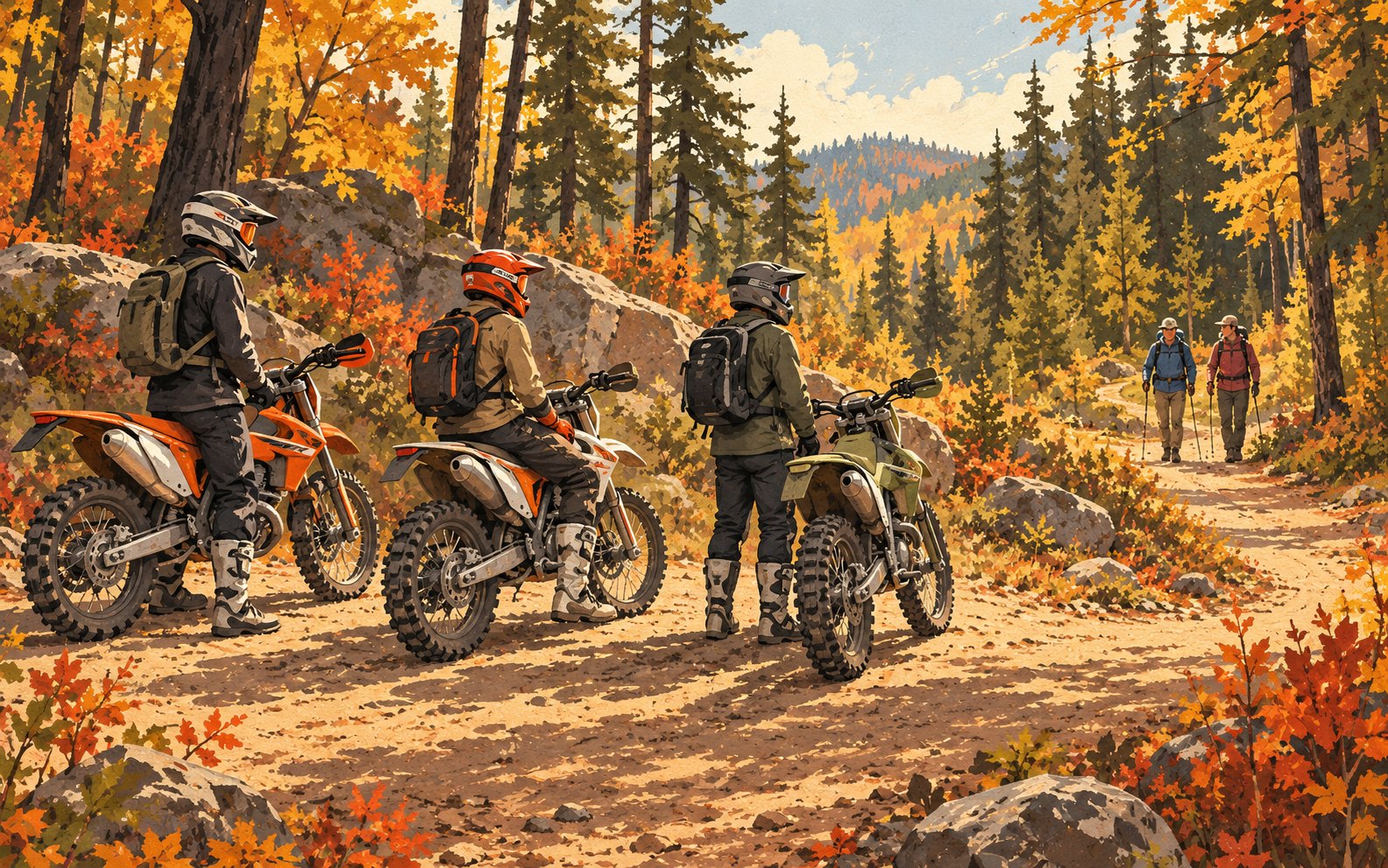
Before engines start, make sure everyone can explain the day’s plan. For a casual group, WrenchMoto suggests naming a lead rider and a final rider, choosing places to regroup, and agreeing that anyone can request a shorter route. Ask about comfort with the proposed terrain rather than assuming everyone wants the same pace.
Tread Lightly!’s dirt-biking guidance recommends riding with companions and designating meeting areas. Share the route with everyone, and discuss what to do if someone misses a turn. A plan that depends entirely on following one motorcycle deserves another look. [1]
MSF warns that following another rider too closely can restrict visibility. If dust obscures the trail, reduce speed and increase the gap. Regroup where stopping is safe and the route remains clear. [2]
Know who is behind you
Know your position in the group and how many riders remain behind you, especially on two-way trails. Stay the Trail describes a courtesy convention: hold up fingers for the riders still following you, rather than the total group size. Two riders behind means two fingers. Its convention uses five fingers for five or more riders and a closed fist for the last rider in that group. [4]
Treat this as a common courtesy convention, not a universal signal system or proof the trail is clear. A closed fist only describes that rider’s group; independent riders or another group may still follow. Agree on the convention before departure, keep your count current at regroup stops, and check local guidance. [4]
Local guidance can differ. New Hampshire’s state-approved safety course relays Fish and Game’s advice against hand signals to oncoming riders. Keep control first: do not remove a hand while braking or riding technical terrain. Slow down and stop safely where the trail remains clear, then speak when a hand signal would compromise control. [5]
Share the trail calmly
Tread Lightly! advises yielding to hikers, mountain bikers and horses, keeping noise and dust down, and riding slowly around crowds and camps. Read the local signs as well. Leave room for other people to enjoy the same place. [1]
When approaching horses, slow down early and communicate calmly. The Forest Service’s Fish Creek Meadows guide tells OHV users to pull over and shut down the engine when encountering horses or pedestrians. Stop in a safe place without damaging the trail edge, and let the horse handler guide the interaction. [3]
At each planned break, count people before discussing the next section. Give everyone a chance to mention a problem without an audience of running engines. A few clear decisions at a stop are more useful than asking a struggling rider to keep making decisions while trying to catch up.
Sources & riding information
- Tread Lightly!: responsible dirt biking and trail etiquette.
- Motorcycle Safety Foundation: Tips and Practice Guide for the Off-Highway Motorcyclist (March 2015).
- Nez Perce-Clearwater National Forests: Fish Creek Meadows, OHV trail etiquette.
- Stay the Trail: passing other vehicles and riders-behind hand signals.
- New Hampshire state-approved Offroad Ed course: Fish and Game hand-signal caution.
Sources checked Oct 22, 2026 (UTC). Access and conditions can change; check current land-manager guidance. Written advice does not replace hands-on instruction.